
Nurses on the Frontline
Nurses on the Frontline
Arrested For Refusing To Take Blood From An Unconscious Patient—The Alex Wuebbels Case
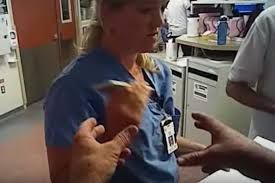
RN Alex Wubbels, Salt Lake City, Utah, July 26, 2017, just moments before her arrest. Screenshot taken from You Tube video published by Salt Lake City Tribune https://youtu.be/ihQ1-LQOkns
Salt Lake City and University of Utah will each pay half of $500K settlement to nurse who blocked blood draw
FACTS
Marcos Torres crashed into a semi-truck while fleeing from Utah Highway Patrol troopers and died at the scene. William Gray, the semi-truck driver and part-time police officer, was severely injured and taken to the University of Utah Hospital in a coma.
Police officers arrived and ordered RN Alex Wuebbels to draw blood from Gray. They had no search warrant and Gray was not under arrest.
Wubbels respectfully declined to follow the order based on hospital policy which required one of the following three conditions to be met before drawing blood from a patient when ordered by law enforcement:
- the patient consents which they cannot do while unconscious; or
- the patient is under arrest; or
- law enforcement has a search warrant.
After a short discussion, the police officer forcibly arrested Wubbels and placed her in his patrol car in handcuffs where she was held for 20 minutes before being released without charges. The incident, captured on police body camera footage, led to widespread public outrage, a settlement, and policy changes regarding interactions between police and healthcare workers.
Resolution and impact
Salt Lake City and the University of Utah will each pay half of a $500,000 payment that settles a dispute over the arrest of nurse Alex Wubbels after she barred a police officer from drawing blood from an unconscious patient.
The settlement, announced Tuesday, ended the possibility of a lawsuit by Wubbels, a University Hospital nurse whose July 26 arrest by Salt Lake City Police Department Detective Jeff Payne sparked widespread outrage after her attorney released body camera footage of the episode on Aug. 31.
Matthew Rojas, spokesman for Salt Lake City Mayor Jackie Biskupski, confirmed the city and university are each putting in $250,000 for the settlement.
“We’re glad we could come to a resolution with nurse Wubbels,” he said Thursday. On Wednesday, hospital spokeswoman Suzanne Winchester described Wubbels as an outstanding nurse and said that “we commend her for putting the patient first.” The arrest prompted the hospital to modify procedures and retrain staff regarding how law enforcement agencies interact with the U.’s health care system, Winchester said.
“Our hope is that the implementation of these new procedures will ensure a situation like this doesn’t happen again,” she said.
Wubbels used part of her settlement money to create a fund to help people obtain body camera footage and also became involved with the American Nurses Association's #EndNurseAbuse campaign.
Utah passed a law in March 2018 which clarified that law enforcement officers in Utah may only obtain a blood sample for a criminal investigation if one of three conditions is met:
- They have the individual's or their legal representative's oral or written consent.
- They obtain a search warrant.
- A judicially recognized exception to the warrant requirement exists, such as exigent circumstances.
Relevant Supreme Court Authority
Missouri V. McNeely, 569 U.S. 141 (2013)
McNeely, stopped for speeding and crossing the centerline, declined to take a breath test to measure his blood alcohol concentration (BAC). He was arrested and taken to a hospital. The officer never attempted to secure a search warrant. McNeely refused to consent, but the officer directed a lab technician to take a sample. McNeely’s BAC tested above the legal limit, and he was charged with driving while intoxicated. The trial court suppressed the test result, concluding that the exigency exception to the warrant requirement did not apply because, apart from the fact that McNeely’s blood alcohol was dissipating, no circumstances suggested that the officer faced an emergency.
The Missouri Supreme Court and U.S. Supreme Court affirmed. The Court looked to the “totality of circumstances,” declining to announce a per se rule. When officers in drunk-driving investigations can reasonably obtain a warrant before having a blood sample drawn without significantly undermining the efficacy of the search, the Fourth Amendment mandates that they do so.
Circumstances may make obtaining a warrant impractical such that dissipation of evidence will support an exigency, but that is a reason to decide each case on its facts. Blood testing is different in critical respects from other destruction-of-evidence cases; BAC evidence naturally dissipates in a gradual and relatively predictable manner. Because an officer must typically obtain a trained medical professional’s assistance before having a blood test conducted, some delay between the time of the arrest and time of the test is inevitable regardless of whether a warrant is obtained.
Mitchell v. Wisconsin, 139 S. Ct. 2525 (2019)
Mitchell crashed his car near Sheboygan, Wisconsin. When police arrived, they used a breathalyzer to test his blood alcohol content. Mitchell registered a 0.24% BAC and was subsequently arrested for OWI.
As police were driving him to the police station, Mitchell fell unconscious, so the officers drove him to a local hospital where his blood was drawn intravenously. The blood test registered a BAC of 0.22%, well over the legal limit, and Mitchell was charged with drunk driving.
Motion To Suppress BAC Results
Mitchell asked the trial court to exclude the BAC results on the grounds that taking his blood while unconscious was a warrantless search which violated the Fourth Amendment. The trial court refused to exclude the evidence and Mitchell appealed to the US Supreme Court which held that when a driver is unconscious and cannot provide consent for a breath test, the exigent circumstances doctrine allows for a blood test without a warrant.
Criticisms of the Mitchell v. Wisconsin ruling center on its erosion of Fourth Amendment warrant requirements, creation of a broad, new "presumption of exigency", and procedural issues related to the scope of the case itself.
Key criticisms from dissenting justices and legal analysts include:
- Undermining the Warrant Requirement: The primary criticism is that the ruling needlessly bypasses the general Fourth Amendment requirement for a warrant, even when police might have time to obtain one. Critics, including Justice Sotomayor, argued that if there is time, a warrant must be secured.
- Creation of a De Facto Categorical Exception: The plurality opinion was criticized for establishing an "almost always" (de facto categorical) exigency exception for unconscious drivers, a departure from the "totality of the circumstances" analysis mandated by previous cases like Missouri v. McNeely.
- Availability of Modern Warrants: Dissenters argued that the premise that police must choose between attending to medical needs and obtaining a warrant is often "false" in the modern era, as warrants can frequently be secured quickly via phone or email while a suspect is en route to the hospital.
- Procedural Impropriety: Justice Gorsuch's dissent, a point echoed by legal scholars, argued the Court overstepped its bounds by resolving the case on the exigent circumstances doctrine, an argument Wisconsin had not adequately presented or relied upon in the lower courts. He felt the case should have been dismissed.
- Ambiguity and Inconsistent Application: Legal scholars have noted that the ambiguity surrounding the "presumption" of exigency and the burden of proof has led to differing interpretations and a "patchwork of rules" in state courts, potentially jeopardizing consistent Fourth Amendment protections.
- Expansion of Exigency: Some analysts suggest the ruling, by using "broad health and safety language," opens the door for a potentially broad expansion of the exigency exception beyond the specific context of unconscious drivers.
This begs the question whether states can create their own laws which offer more privacy protection than Mitchell? The answer is yes, states can create their own laws and constitutional provisions that provide more privacy protection than the U.S. Supreme Court's ruling in Mitchell v. Wisconsin.
This is because the U.S. Constitution sets the minimum level of protection for individual rights across the country. State supreme courts are the final arbiters of their own state constitutions and have the authority to interpret their state laws to provide greater protections than those guaranteed by federal law, under the doctrine of "adequate and independent state grounds".
This means that states with explicit rights to privacy in their constitutions (such as Alaska, California, Florida, and Washington) or those with more expansive interpretations of their search and seizure clauses may require a warrant for an unconscious driver's blood draw, even if Mitchell suggests it is not always necessary under the Fourth Amendment's minimum standards.
- Divergent State Court Rulings: In the wake of Mitchell, some state courts have continued to require a more rigorous application of the "totality of the circumstances" test for exigency, rather than the "almost always" presumption that the Mitchell plurality endorsed.
- Legislative Action: State legislatures can pass statutes that impose stricter warrant requirements or clarify the circumstances under which a blood draw is permissible, offering more protection to individuals than federal case law requires.
Therefore, while Mitchell v. Wisconsin outlines the federal standard, individual states have the power to prioritize a higher level of privacy for their citizens through their own laws and judicial interpretations.
An example is the 2025 decision by the Pennsylvania Supreme Court in Commonwealth v. Hunte, 337 A.3d 483, 487 (Pa. 2025).
The court held that, in drunk-driving investigations, the natural dissipation of alcohol in the bloodstream does not constitute an exigency in every case sufficient to justify conducting a blood test without a warrant. Whether a warrantless blood test of a drunk-driving suspect is reasonable must be determined case by case based on the totality of the circumstances.
WASHINGTON LAW
Healthcare providers are generally immune from civil and criminal liability when they collect a blood sample at the direction of a law enforcement officer, provided certain legal conditions are met. Specifically, the Revised Code of Washington (RCW) 46.61.508 states that a qualified person who withdraws blood "shall not incur any civil or criminal liability as a result of the act of withdrawing blood from any person when directed by a law enforcement officer to do so".
Additionally, RCW 18.130.410 states that it is not professional misconduct for specified healthcare professionals to collect a blood sample without a person's consent if they are directed by law enforcement to do so under the provisions of a search warrant, a waiver of the search warrant requirement, or exigent circumstances.
This immunity does not, however, protect the health care professional from civil liability or professional discipline resulting from the use of improper procedures or a failure to exercise the required standard of care in the physical act of drawing the blood itself.
The law enforcement agency requesting the blood draw would be responsible for any issues arising from the lawfulness of the request itself.
Legal References
Bianca Valdez, Everyone Bleeds Guilty: Blood Draws for Law Enforcement Purposes in Light of the HIPAA Privacy Rule and Recent Supreme Court Decisions, 52 UIC J. Marshall L. Rev. 489 (2019).
Tessier W, Keegan W. Mandatory Blood Testing: When can police compel a health provider to draw a patient's blood to determine blood levels of alcohol or other intoxicants?. Mo Med. 2019 Jul-Aug;116(4):274-277. PMID: 31527966; PMCID: PMC6699816.
For more related video:
https://youtu.be/81d5VM8xfpM